Maps of meaning
A map is useful when it helps a person choose a next step. This one shows the practices that keep the garden alive, not a complete inventory of its contents.
The working loop
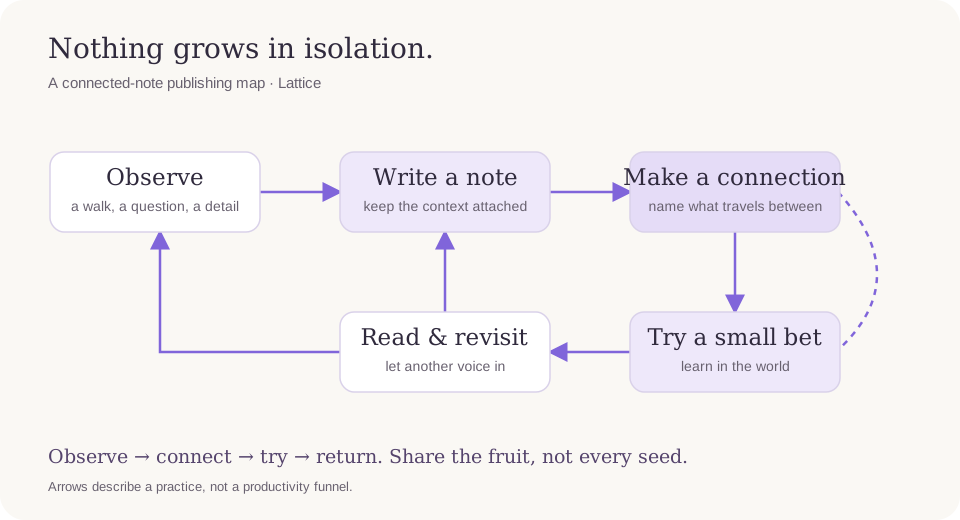
Observation gives a note something to answer to. Reading introduces another voice. A connection names what can travel between them. A small experiment returns the idea to the world, where it can be corrected.
The diagram is one responsive SVG with a descriptive title and text; it is a working illustration, not a photograph.
Attention → place → practice
Attention is a material changes what I look for. Walking as research gives that looking a repeatable form. A neighborhood atlas asks whether the result can be useful to someone else.
Reading → patterns → design
The reading room is the source shelf. Patterns and places holds a useful disagreement. Lattice turns some of the questions into an interface without claiming the books as endorsements.
Writing → revision → hospitality
Digital gardens supplies the practice. Against the finished thought names the responsibility. A quieter internet asks whether the resulting place respects a reader's freedom to leave.
A paragraph worth carrying
The block above is embedded from the original note, so the reminder has one place to be tended. A good map should reduce duplication as well as confusion.
For the authors and ideas connected by these sample notes, see People and influences.